Julie Goodwin’s Essential Cookbook: the book

Julie Goodwin's Essential CookbookThis book was sent to me by the publisher, Hachette, at no cost. RRP $39.99; out now.

This is an overview of the book as an object; I’ll discuss some of the recipes tomorrow.

The cover makes this seem like it’s going to be all about baking; it most definitely is not. In fact, baking and dessert are a relatively small portion of the book.

In her introduction, Goodwin says this is “a collection of everything I think is important to know in order to be able to nourish yourself and the people you love”. It’s home cooking, not Palomar. So it’s much more my sort of thing.

The book is divided into sensible but also intriguing chapters: Eggs; Meat; Poultry; Seafood; Sauces, soups, and dips; Vegetables and Preserves; Baking; and Desserts. In that order. They largely make sense, although sauces, soups, and dips isn’t intuitive to me. What I do like is that each chapter has differently coloured page numbers, and they progress down the side of the page so all teal Egg pages are grouped, and so on. Easy to flick to the chapter you want just by looking at the edge of the book.

The meat section is divided into beef, pork, and lamb, while poultry is chicken, duck, turkey and quail. Seafood is shellfish, fish, squid and octopus. The vegetable chapter is mains, sides, salads, dressings, pickles and preserves. Each chapter has a short introduction to the chapter. This is fairly extensive for the meat chapters, with information about how to cook different cuts.

Not all of the recipes fit onto one page, which could be a bit annoying if you need to flick back for ingredients. I think this is partly because not every recipe has a picture, so you’re getting more recipes into the book (only 310 pages including index etc) than you otherwise might. It just means you need to take that into consideration. The recipe pages themselves are set out with nice wide margins, and nice spaces between each step, so it’s straightforward to figure out where you’re up to (and add notes if necessary); the headings for each recipe are easy to find and the ingredients are a different colour from the method, which I really like. What photos there are are generally indicative of the finished product, and don’t come across as TOO highly workshopped. The index seems quite thorough.

As an object, this is a nice book. It’s got perfect binding and the flop is surprisingly good. The paper is thick enough that splatters aren’t going to ruin it and I’ll be able to write on them without going through to the page behind.  The front and back covers have half-flaps, which I personally like to use as bookmarks.

A couple of nit-picks: in the Cook’s Note, Goodwin says that for her, shallots are “the long green onions that are sometimes called spring onions”. I found this quite surprising since I don’t remember coming across an Australian author who didn’t just use spring onions! And in the baking section, there’s an instruction to whip eggs and sugar until there’s a ribbon… and in the next recipe, there’s an explanation of what “a ribbon” actually looks like. I can only assume that the recipes were originally in a different order.

I got to interview Julie briefly, too.

Acts of Kitchen: Jo runs a cafe

AoK_logo_v2In which I make hot cross buns and cook from Julie Goodwin’s new cookbook (my interview with Julie), and chat to the wonderful Jo, who runs John Gorilla. (You really want to follow their Instagram account, too.)

My Patreon: recipes and postcards and even food!

Hot cross buns! From Bake Class.

IMG_1439.JPG

Interview: Julie Goodwin

Julie Goodwin2017.jpg

Julie Goodwin was Australia’s first MasterChef. You can find her online, where there’s a bunch of great recipes as well as information about classes that Julie runs.

Tell me how you came to cooking. Is it something you’ve been doing since childhood, or came to later?

I have some great memories of cooking with Mum as a kid, but it was really only when I had my own kitchen to mess up that I really got started. Part of that was coming to the realisation that if I was going to eat nice food, I would have to work out how to cook nice food!

 Who are your inspirations when it comes to cooking?

My food philosophy of sharing meals and entertaining comes from my mum. Other cooks who I greatly admire are Margaret Fulton, Stephanie Alexander, Maggie Beer and Nigella Lawson.

Do you have a favourite ingredient? 

It’s hard to pick one favourite ingredient but I get nervous if I don’t have eggs, lemons and garlic in the house.

Are there ingredients or techniques that scare you?

I’ll give anything a go, I’m not scared because I’m not scared of failing. I reckon if you’re not having a kitchen disaster every now and then you’re probably spending too much time inside your comfort zone!

Cooking is one thing; compiling a cookbook is something quite different! You’ve got a number of books under your belt now; what inspires you about creating them? 

I find food inspiration everywhere – when I visit friends, or travel, read books or magazines or talk with other food lovers. My latest book was really inspired by the fact that my three sons are now all young adults, and I wanted a book for them that would teach them what they needed to know – the building blocks of cooking, along with the recipes we have enjoyed over the years.

In ten years’ time, what would you like to have achieved or changed?

Julie Goodwin's Essential CookbookGosh, considering what the past ten years has held I can barely even begin to speculate where the next ten years will take me. I’ll work hard, keep my eyes open for opportunities, and who knows what the next ten years will bring!


Julie Goodwin’s Essential Cookbook
($39.99), published by Hachette Australia, is out today. 


Acts of Kitchen: Shalini on food and family and the CWA

AoK_logo_v2In which I experiment with not-meatballs and Shalini talks about growing up Fiji Indian, curries, baking, experimenting, and being a founding member of a new, city-based CWA (Country Women’s Association).

The not-meatballs I made.

I set up a Patreon page!

Acts of Kitchen: Tas on Greek Cypriot food

AoK_logo_v2In which I make  another chiffon cake (this one chocolate), and Tas talks about Greek Cypriot food and makes me hungry.

Some of the recipes Tas mentions:

Sheftalia

Kolokasi

img_1405-copyFlaounes

Interview with Kate, whose jam I used in the cake.

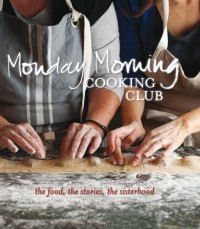
Monday Morning Cooking Club interview

mmcc_frontcover_fin-copy-539x618

Bread and butter

mmccthefeastI don’t have the opportunity to cook epic desserts all that often, so I quite like grabbing them when they pop up. A crowd of thirteen is exactly that, so I went to The Feast Goes On (two of the editors of which I got to talk to  a few months back) because I knew there were some desserts in there that I’d tagged as Must Try. And because I have a pile of oranges from my veg box, I went with the Orange Bread and Butter Pudding. (If I’d had more energy and thought about it ahead of time, I would have made the cake featured on the cover because WOAH.)

IMG_1398.JPGThis bread and butter pudding is to your classic version as chocolate mud cake is to your average cocoa-only cake. For a start, it uses brioche. Yes. And then you segment three oranges (having zested two of them). Then you pour over warm marmalade – I used Kate’s De Milo marmalade which has oranges and blood plums and bits of crystallised ginger (and you can hear my interview with her here). Then it’s all about the cream and the eggs and not drooling over it.

It was magnificent. And dead easy, for something that looks and tastes so very epic. I’ll be making this again… when I need to make something to impress folks…

IMG_1399.JPG


Cooked, by Michael Pollan

images.jpegThis book was recommended to me by the sourdough baker whose course I took. It turned out that I had already one of Pollan’s books – The Botany of Desire, which was awesome and looked at various plants in light of the general idea of desire. (My biggest take away message: the Agricultural Revolution was the grasses using humanity to destroy the trees. Also that all edible apples are clones.)

This book is Pollan’s attempt to learn more about cooking, having looked at the gardening and the eating side for a long time. He divides the book into four sections: Fire, Water, Air, Earth. Or, basically: barbecue, braise, bread, and fermenting. Continue reading “Cooked, by Michael Pollan”

Istanbul Cult Recipes: the recipes

unknownWhat I thought of the book itself.

Now, the recipes!

Things I’ve made:

“Lady’s thighs” – these are kofte (uh, not softie, autocorrect) that are apparently meant to be shaped like lady’s thighs? Or something. Anyway, steak and rice and some spices – very simple, very tasty.

Beef dumplings – ‘manti’, “the unmissable little Armenian dumplings”. Simple dough (flour and oil and a little water); a spoonful of minced beef and onion into the middle of 6cm squares, fold them up into boats and bake in the oven with some broth around it. SO good. I plan to experiment with spices… and they freeze brilliantly.

Zucchini fritters – zucchini, eggs, dill, parsley, feta. Fry. Delight.

Lentil balls – my one failure so far. They tasted fine… but they didn’t become balls. They wouldn’t stick together, so I used it as a basis for meatballs. Still: lentils and burgh and garlic and chilli paste and parsley and spring onions…

Shortbread – actually the first thing I made, for a church fete. They got a good rap because, as someone said, they’re not toosweet. They’ve got flour and almond meal (the ground walnut option is intriguing), and only 80g caster sugar for 500g other dried ingredients. Easy to make, easy to eat.

Things I want to make:

Milk buns with feta kneaded through… :O

Lentil soup – so easy! red lentils and tomato…

Stuffed vine leaves – I’ve always been dubious of my ability to make these, but you can use silverbeet! instead of vine leaves! and somehow that seems more accessible.

Borek – filo (although given where I leave I might be able to access yufka pastry…) with feta… sounds awesome.

Almond helva – although making my own helva could be a deeply dangerous thing to do HOW GOOD WOULD THAT BE?!

Things I won’t make:

I can’t come at tripe. Uh, no. I also don’t think I can access mutton so I guess I’ll try some stuff with lamb instead…

Istanbul Cult Recipes

This is the book I haven’t been able to mention on the podcast! And now I can!

This was sent to me by the publisher, Murdoch Books, at no cost. It’s available now; RRP $49.99.

Unknown.jpeg

The book itself

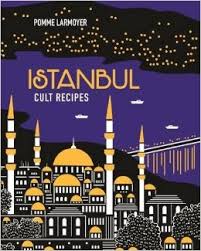
is a lovely object. My copy is a hardback and the image on the front is delightful; the bits that look yellow in the pic to the left are actually gold. It’s a hefty tome, with about 250pp of recipes and good thick covers.

The book is divided into several sections: At the Kahvalti Salon (breakfast); The Meyhane Table (meze and fish); Lokanta, Kofteci, Kebabci (soups, meats and rice); At Home (family recipes); Street Food; and Turkish Delights (sweet things). It’s an intriguing division, especially that central set of chapters, because they don’t correspond to meal times as other books often do. Instead it’s more about the style of food, which I quite like, once you’ve got your head around how to look for particular sorts of food.

The other intriguing aspect of the book is that it’s not just recipes. It’s not even just recipes plus stories about the people. No; Larmoyer is toying with the reader/cook and may be in cahoots with the Turkish tourism board because each chapter also has a double spread on where to go in Istanbul in order to eat. There’s a map and a list of the best places to go for different specialities. Which… seems a bit cruel, really. But at least the book provides recipes to help those of us who can’t up and run to Istanbul at a moment’s notice.

The book is replete with pictures of both the food mentioned and the places where it’s bought and made. The recipes are laid out across a single page, with a story or tip for each one; pretty much all have at least one photo accompanying the recipe. A lot of these photos look quite domestic – I’m sure a lot of thought went into styling them to get the effect, but I do find it reassuring to see a photo, when flicking through the book, that doesn’t look too enormously different from what would be possible in my own kitchen! (Except for the pictures of producing epic quantities of baklava. EPIC.) The ingredients are listed in bold type, which I like, and so far they seem straightforward to follow.

As a book, this is a very attractive object. Find out tomorrow what I thought of the recipes! (… eh, spoiler: they’re good.)