 In which I experiment with not-meatballs and Shalini talks about growing up Fiji Indian, curries, baking, experimenting, and being a founding member of a new, city-based CWA (Country Women’s Association).
The not-meatballs I made.

In which I experiment with not-meatballs and Shalini talks about growing up Fiji Indian, curries, baking, experimenting, and being a founding member of a new, city-based CWA (Country Women’s Association).
The not-meatballs I made.
The question posed: can I take a meatball recipe and, rather than cook the meat in balls in a sauce, cook it all together so it’s like what I would call a bolognese-type sauce, and which Americans might call something like chilli?
Let’s find out!
I decided to use a recipe from Saffron Tales only because I had loved it recently and I had prunes to use up; I intend to try this with the meatball/kofte recipes in Jerusalem, too. The meatballs there are stuffed with barberries and walnut and prune, and simmered in a sauce of tomato and onion and prunes and so on. Oh and the meatballs have cooked rice in them.
So I made the sauce pretty much to spec, and then just… put in the mince, and all of the other ingredients (except the walnuts, which I added at the end) (oh and garlic because I ran out; how even does that happen?). I didn’t pre-cook the rice, just threw that in too, and added a bit more water to compensate. And let it simmer for maybe an hour or so? For the meatballs it said to simmer for 50 min; I figure bolognese sauce is always better when it’s all been cooking down together, so the same principle seemed to apply here.
And the verdict was: yes! This is a good option! I won’t stop making meatballs because there is definitely a place for that, but the place for THIS is in the dehydrator and making me ever more interesting food to take camping. I am very pleased with the results.
 In which I cook from Pulse and admire the beans of my garden, and Asher talks about his love of food. And
  cooking. He really likes cooking.
I was dubious about Netflix but I have really enjoyed it over the last few months. And the other day I discovered that they had partnered with Michael Pollan to create a four-part documentary based on his book, Cooked, and I got very excited! Happily, it did not disappoint.
The show is clearly made after the book has been published; it begins and ends with Pollan reading at a book launch or author event, and there are a couple of points where people are reflecting on what they taught Pollan. It covers a lot of the same ground: it’s broken into the same four elements/chapters, and talks about many of the same types of cooking – which is to be expected. But there are some significant differences, partly to do with it being tv and partly, I suspect, for other reasons.
There really is a difference between reading about someone cooking – making mire poix, or throwing half a pig on a barbecue, or turning a cheese – and seeing someone do it. So in that way, this is a more… visceral experience. There’s something about actually seeing the meat or the cheese or the vegetable, or the bread rising, that is deeply delightful. So there’s that.
Also, though, I found the show appeared more diverse. Again, this is partly because of the medium: I easily forget who’s talking and of course colour isn’t always obvious from a name, even if gender often is. But when the Moroccan/Indian/Aboriginal person is on the screen – well, the colour of their skin is part of what you see. And people were often filmed in their homes, so those are visible too, in their wonderful diversity. That was significant. I definitely felt like there were more women in the show, talking about the how and why of their cooking – that was something I really appreciated. And along with all of those things, making them even better, is that Pollan allows those people to speak for themselves. There are whole minutes without Pollan on the screen! Mostly he’s not even interviewing people – I don’t think he’s even there. Yes, there’s a lot of Pollan cooking and talking about his research, and that’s fine – it’s part of the premise of the show, and he’s a genial person and easy to listen to. But the Moroccan baker and the Indian cooks and the Aboriginal women hunting for goanna: they get to speak about their own relationship with food and elements and culture, and it’s great.
This was a great documentary series. Highly recommended.
 In which I attempt pie and do things with eggplant. Some success, some… not so much success.
Interview with Andrew (who makes tarts/pies)
Kate (who makes quince jelly called Harmony)
 Less than aesthetically pleasing pie.
… is a terrible heading, and I am sorry.
Anyway: I made pickles! I pickled pears, and I pickled eggplant.
The pears were courtesy of a friend who managed to salvage 2kg of them from a tree before the rosellas ate them all. I had had pickled pears at Kate’s house, with cheese and then in a chicken salad, and NOM. These were different from the ones she had: I used white vinegar and cinnamon and cloves; I used a recipe that was meant to be for pickled peaches (whichL whoa. If ever I get cheap peaches…). Kate used cider vinegar and rosemary and pepper corns; that will be my next trick, if I get more pears.
The eggplant were from my garden, because BY GOLLY I’m getting a lot. Trying to figure out when the darned things are ripe has been a hassle, since the first info I looked at was all about what the fruit look like on the INSIDE… which is less than useful. Finally I found someone who said eh, if the skins are shiny they’re probably fine. Which meant I got to go and harvest a lot. So I made pickles! They don’t look very appetising, hence no photo, but they have turmeric and cumin and lots of ginger (side note: I discovered that peeling ginger with a spoon is EXACTLY as awesome as all those people have ever said).
I am now about to make moussaka with more of the eggplant, so hopefully that goes well…
 In which I make another chiffon cake (this one chocolate), and Tas talks about Greek Cypriot food and makes me hungry.
Some of the recipes Tas mentions:
Interview with Kate, whose jam I used in the cake.
Monday Morning Cooking Club interview
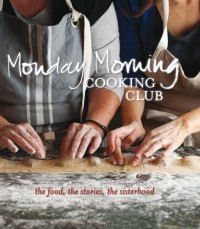
 I don’t have the opportunity to cook epic desserts all that often, so I quite like grabbing them when they pop up. A crowd of thirteen is exactly that, so I went to The Feast Goes On (two of the editors of which I got to talk to a few months back) because I knew there were some desserts in there that I’d tagged as Must Try. And because I have a pile of oranges from my veg box, I went with the Orange Bread and Butter Pudding. (If I’d had more energy and thought about it ahead of time, I would have made the cake featured on the cover because WOAH.)
 This bread and butter pudding is to your classic version as chocolate mud cake is to your average cocoa-only cake. For a start, it uses brioche. Yes. And then you segment three oranges (having zested two of them). Then you pour over warm marmalade – I used Kate’s De Milo marmalade which has oranges and blood plums and bits of crystallised ginger (and you can hear my interview with her here). Then it’s all about the cream and the eggs and not drooling over it.
It was magnificent. And dead easy, for something that looks and tastes so very epic. I’ll be making this again… when I need to make something to impress folks…


In which I make a chiffon cake and a kale (I know) and potato pie, and Kate talks about the amazing world of jams and jellies and chutneys and marmalades.

The Monday Morning Cooking Club, and my discussion with them.

Kate’s website, and Facebook page
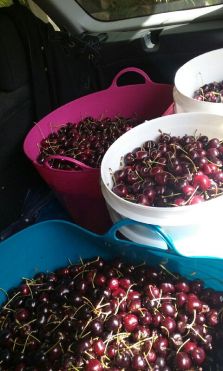
An example of the amount of fruit she sometimes gets:
 In which Anne talks about feeding Lucy (12 months old), and I talk about Christmas food.
 Anne’s first appearance on Acts of Kitchen.
Bee Wilson’s First Bite, mentioned by Anne.
Gastropod, the podcast we both love.
Send feedback to acts of kitchen at gmail dot com, or leave a comment here… and feel free to leave a review on iTunes!

 Flaounes
 Acts of Kitchen