
 When you have friends coming over for dinner, it makes sense to experiment on them with recipes from a book called Sharing Plates (sent to me by the publisher, Murdoch Books, at no cost; discussion of the book itself).
Rosemary popovers: these are in the Bread section of the book. You make a batter of flour, eggs, milk and rosemary, and then pour it into a muffin pan to bake. These were ok; they popped right out of the muffin holes (maybe mine were deeper than the 60mL specified in the recipe), which was amusing. I found them a bit too eggy to really enjoy like a bread roll, which is what I was assuming they would be like. The recipe calls for it to be served with seaweed butter (adding dried seaweed); I neither have easy access to an Asian grocery nor the inclination to try seaweed this way at home. I put thyme into some butter instead, which is still in keeping with the book as it does say you’re allowed to experiment with other herbs. I made 8, so they certainly count as ‘sharing’ food.
Salad of roasted pumpkin, chorizo, chickpeas, quinoa and blue cheese: from the Snacks and Salads section. I’ll be upfront and say I am made a few alterations to this. I don’t like blue cheese so I used a very good Persian feta instead; I left out the roast capsicum because I couldn’t be bothered; and I didn’t make/use the cabernet sauvignon dressing because I thought the chorizo left enough oil to dress the quinoa, and the chorizo and seasoned pumpkin and feta together all seemed to add enough zing. I did like the combination here of using quinoa and a few chickpeas with the chorizo and roasted pumpkin; the walnuts on top added a good crunch, and the preserved lemon a piquant tang. In the past I have made similar salads with couscous; I think quinoa is a bit lighter, and I’ll tend towards it from now on (remembering to not let it burn in the pot…). I guess salad counts as a sharing food?
Chermoula lamb: I wanted to use the salad, above, so I mixed n matched with the Chermoula lamb with pumpkin couscous, from the Meat section. Perhaps you can buy chermoula somewhere in Australia as a marinade, but I’ve not noticed it. I assume this because the ingredients list says “30g chermoula; 6x80g lamb loins…”. I’ve used chermoula before so I was happy to go make it, but I was really surprised to see if referenced here as something you would just buy. The chermoula/lamb combo was fine. To be honest I don’t really see how this counts as a ‘sharing plate’ since there’s nothing more ‘sharing’ about this than with any other recipe that serves 4-6 people.
Bounty bars: from the Sweets section. I was pretty excited about making these – the ingredients are straightforward (butter, sugar, condensed milk (!!), coconut, chocolate) and I love a Bounty. And yes, they were very tasty, and of course licking the bowls was lovely. However the instruction that “Using two forks, dip a bar into the melted chocolate and roll to coat all sides. Use one fork to remove the bar from the chocolate and the other to wipe off the excess chocolate” (p213) is deceptive. That process was far more difficult than implied: the bars had been in the freezer, to solidify, so the chocolate just stuck to them really quickly – removing excess was hard. And just getting them into and out of the chocolate was a process. Perhaps I need to use a wider-mouthed bowl, but that’s not specified in the instructions. In the end, because of how annoying the process was and because of just how much chocolate was ending up on each bar, I gave up on covering the whole thing and went with fairly serious drizzling instead. This was far easier and still, I think, deposited a good amount of chocolate on the bar. Having learnt this trick I would be happy to make these again. I did indeed make the 15 suggested by the recipe… they do count as a ‘sharing’ plate in that respect, although given that they are meant to last for a week in an airtight container, you could just as easily not share them…
At other times…
Sumac-spiced pork and vela meatballs with fontina mash: the meatballs were great, although I couldn’t pick up the sumac, which was sad and perhaps not surprising since you put in the same amount of ground coriander, and then some allspice, paprika, and pepper as well. The recipe calls for you to have bacon in the mix, which I think is intriguing, as well as pork back fat… which I couldn’t find, so I just left it out. Not sure what difference it would have made, of course; perhaps smoother texture? I thought they were fine, anyway. The tomato sauce had anchovy in it, which I like for the salt and umami flavour. The potato mash was intriguing – milk, cream, butter, parmesan, and fontina. I did not add cream, because I don’t tend to have it just sitting around, but I did go out and buy some fontina specifically. Fontina is not a cheese I would willingly eat, being much stinkier than I enjoy… but I was intrigued by its addition to the mash, and I quite liked it. Having said that, I don’t think I’ll go out of my way to source fontina for future mash: it’s not that easy to find, and it’s not particularly cheap, either. I’d be happy with either more buttery mash, or adding parmesan. The meatballs and the tomato sauce were very nice. Once again, unconvinced that this really deserves the moniker ‘sharing plate’; yes you can share it, yes it would be a nice cosy dinner party meal, but… it’s not something other than that.
Lamb empanadas: certainly count as sharing plates, and these were delightful. However, the info bar at the top said it made 10 empanadas; the ingredients list specifies 4 sheets of puff pastry; and the instructions say to use a coffee mug or glass to cut “10 rounds from each sheet”…
Things I haven’t cooked but give a sense of what the book is like: the first recipe is Quail eggs benedict with chilli kale on mini muffins; the final recipe is Soft Swiss meringue with berries and almond anglaise (actually the very last recipe, in the Basics section, is Wasabi Dressing).
 This book was sent to me by the publisher, Hachette, at no cost. It’s out now; RRP $39.99.
 Scones! I have made scones before, and have recently discovered that the point is to mix them very lightly. Goodwin makes this point strongly. They weren’t perfect but that’s my fault: I didn’t turn the oven on early enough so it wasn’t as hot as it should have been, and my guest was arriving soon… so I had to cook them for longer than prescribed. Nonetheless they were quite tasty, and as light in texture as I had hoped. I am intrigued by the notion of adding lemon zest; I didn’t add as much zest as suggested (three lemons’ worth) partly because I wasn’t going to make the curd (next time, Gadget) and partly because I didn’t want the lemon to overwhelm the jam I was going to use (it was
  I enjoy wine, but I am by no means a connoisseur. For me, going to an event like this (with friends
  In the first bracket, I was a bit embarrassed to admit that I really didn’t enjoy the 1993, although it did actually improve with some air (I’ve always been a bit sceptical of this claim). The 1995 was definitely my favourite of this trio, although the 1997 was also fine. The 21st century wines, however, were far more to my liking. The 2004 in particular was very drinkable… we later discovered that this vintage was stored in new oak, which basically equates to sugar in wine-making terms; thus, no surprises. The 2006 was fine – I would drink it although it wouldn’t be my choice; I found it too dry – and and 2011 was a bit meh, although it too improved with some air; it didn’t have quite the flavour of the 2004. The last pair were intended to be a bit special, and they certainly were. Sometimes I have tasted wine that’s meant to be all ‘this is the reason we have a top shelf’ and I’m all ”I’d pay $25 a bottle”. The 1998 magnum was quite tasty. The 2004 Coronamento, though, was definitely the best wine of the evening. I don’t have the training to use all the proper wine-snob words, so all I can say is: it was very, very tasty.
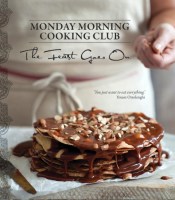 I received a copy of the Monday Morning Cooking Club’s book The Feast Goes On from the
  ended up having to cook it for longer. Which was fine but I felt stupid. I will make this again and I will use a bigger dish.
 Labneh kreplach tortellini: probably my favourite recipe to date. Kreplach are “the Ashkenazi Jewish version of Italian ravioli, Chinese wonton or Russian pelmeni.” Palomar suggests making
  them like choux (choux? I can
  Verdict: I’m not sad to have experimented with it, but I wouldn’t be rushing out to buy it for all my friends. Possibly I’m spoiled by Jerusalem plus my two Sabrina Ghayour books, and The Saffron Tales, which basically cover these sorts of recipes – the ones I’ve enjoyed anyway. That said, I am looking forward to trying the date roulade, and their version of pitta bread.
 Acts of Kitchen