Indian Made Easy: the book itself

9781743368565.jpgTrue story: a few weeks ago we ordered Indian takeaway and it was dire. My beloved, frustrated, announced “we must learn to cook good Indian!”

Two days later, Indian Made Easy appeared on our doorstep, courtesy of Murdoch Books (published July 2016, RRP $39.99).

It’s not like we’ve never cooked Indian food before. I love the cookbook Bowl Food and it has a few excellent curries in it, complete with long list of spices to make your own pastes etc. But it was exciting to to get an actual Indian cookbook when I’d been thinking about it for a while.

The book

A paperback, but still A4 in size. I do wonder whether the cover will crack off the spine at some point – not that it shows any sign of doing so yet, but I’ve seen it happen before. It hasn’t shown any sign of the spine cracking yet, though, which is excellent. I like the cover art – although conflicted with rice being the universal signifier of Indian food, or something – and the fact that the inside cover has the proportion and position of rice/black background reversed.  Continue reading “Indian Made Easy: the book itself”

The Saffron Tales #2

Yesterday I talked about the book itself; today, it’s the recipes.

UnknownThey, too, are great.

Sweets

Sour cherry and dark chocolate biscuits: the first time I made these I couldn’t find sour cherries; that has since been rectified. That first time I used dried blueberries, and they were ok. I really like them with sour cherries – these are some new favourites.

Persian love cake: even though I had no rose water, so I used orange blossom water, this was fantastic. And as Khan herself notes, the cake keeps quite well – I think we ate it over about five days and it didn’t go stale just under plastic wrap in the fridge.

Mains Continue reading “The Saffron Tales #2”

The Saffron Tales

This was sent to me by Bloomsbury at no cost. It appears to already be out overseas, but the Bloomsbury website says it’s out in mid July in Australia. RRP $33.99.

Unknown.jpeg

The book

I love a cookbook with a ribbon.

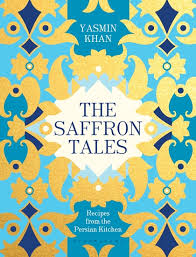
This is a lovely book. I got a hardback version; as you can see, the front cover is gorgeous. I’m a bit torn because the inside cover is also gorgeous, blue with gold writing.

There are photos throughout, not quite of every recipe but close. While I know all of them are staged, they’re not so pretentious as to make me depressed. Each recipe is presented with a little story or explanation in italics to the side, and the recipes are all straightforward to follow.

As well as recipes, Khan presents stories about Iran itself, and some of the people she met during her travels. These are geographical, with sections of Tehran, Isfahan and Shiraz, and Tabriz, for example. Khan doesn’t take the current fashion for Persian food for granted, with an introduction that talks a bit about Iranian culture (she alternates between Persian and Iranian, and explains why at the start of the book) and – admittedly generic – attitudes to food. Plus, and this is something that I really like, there’s an opening discussion of the “The Persian store cupboard”. She given an alphabetical run-down of everything from barberries to yoghurt, explaining their taste and their uses (I’d never heard of golpar before and it’s proving difficult to find). I ALSO really like that she ends this section with the recommendation to “do as the Iranians do and use your taste buds and your eyes to determine which direction a dish should go.” The direction to “just enjoy the process of cooking something new” makes her my new cooking BFF.

Finally, the book ends with a section called Planning a meal (ok, there is also an index, but whatever). Iranian New Year? Persian Picnic? Vegan Feast? Easy weekday suppers? Got you covered.

So, yes, I think it’s clear that this book is a winner. Stay tuned tomorrow for discussion of the actual recipes.

There’s a website!  And the book is available from Fishpond. 

Wholefood from the ground up

This book was sent to me by the publisher, Allen&Unwin, at no cost. The RRP is $39.99 and it’s available 9781743365373.jpgfrom today (May 25).

Recipes I’ve tried

Potato and celery salad with celery leaf pesto

My darling isn’t a huge fan of basil pesto, as a rule, so I was curious to see how he felt about this one. It’s made with the inner celery leaves (the yellowy ones), parsley, capers, pine nuts and pecorino (I used parmesan) plus the other normal pesto bits. And the answer was that he really liked it – as did I. It’s a lot subtler than basil pesto (which I do love), but still very tasty. This recipe puts the pesto with boiled potatoes and inner celery stems. I served it with those and chicken, and ate the leftover chicken with leftover pesto the next day. Very nice.

Baked spicy cauliflower, chickpeas and fresh dates

First change: no fresh dates, so used dried ones. Anyway – cauliflower with cumin and coriander and garam masala, baked; always lovely. Cook onion and add chickpeas, then throw those on top of the cauli and add the tahini which you’ve mixed with orange juice and zest and a bit of sweet. I served this by itself but would definitely make it again to serve with other salads. Very tasty and I enjoyed the mouthfeel of cauli with tahini. I suspect this may become a favourite pairing.

Pocket pie: moroccan-spiced pumpkin, silver beet and goat’s cheese

Look, it’s fair to say that this recipe caused some anguish. This is probably largely on me, because Blereau’s recipe calls for shortcrust pastry to be made from spelt and barley flour, but the two places I tried – the supermarket (I live in a hipster and immigrant area, so it’s not that ridiculous) and a bulk-food place – did not have barley flour. So I subbed in ordinary flour. I did not do the research into whether or how barley flour deals differently with butter compared with ordinary flour. The pastry was very short and I found it very difficult to deal with. There might have been some shouting. Still, with the soothing hands of my beloved we did end up making them, and they were tasty enough; it seemed like a lot of butter, because they went very crispy. The filling was ok – roasted pumpkin with coriander, cumin, and fennel.

Split pea, fennel and winter vegetable soup

Again, neither of the places I checked had green split peas. The supermarket had a spot for them, but they were out of stock. So I used a normal soup mix. This is a very nice soup but it’s not anything out of the ordinary.

Creamy fresh corn polenta with refried black beans

I think I’ve made polenta maybe once, and that was to cut it up into squares and bake it (which was nice). This recipe recommends cooking the polenta in a fatty stock, and I realised that I had a lamb ‘stock’ in the freezer from ages ago – I think it was liquid I drained off some dish and couldn’t bear to throw. So I used that to cook the polenta, and it was delicious. The refried black beans were also really nice, with capsicum and coriander and a little too much chilli for my tastes (c/ beloved being a little heavy handed). We didn’t add the corn to this because we’re not huge fans; I didn’t think the dish suffered for its lack.

I ignored most of the section on ‘basics’, like using kefir grains in… stuff… and preparing and cooking beans, lentils, and grains.

The book itself

It’s a well presented book, as you’d expect from Allen&Unwin; it’s one of those big cookbooks, with what feels like a solid spine, and generally appetising photos throughout. Each recipe has dietary info about whether it’s dairy or gluten free, vego or vegan, and other allergy stuff. However the recipes, while nicely set out on the page, sacrifice font size in favour of white space, which makes reading from a distance something of a struggle – not great from the other side of the stove.

I have two main issues with the book. One is perhaps obvious from comments above: there are ingredients in here that were not easy for me to find. I do not know what kombucha or kefir grains are, nor where to find them. I live near the city, in a hipster area. Probably I could find these things, and I know I could find them online, but the point remains that this is not an easy, automatic book to cook from – and that’s not acknowledged anywhere, as far as I could find. Connected to this is the reality that this is not a book for the economically poor, nor the time poor. This is not necessarily a problem, if you’re buying for yourself and willing to put in the time and money, but it is something that should be acknowledged. Blereau is all in for pre-soaking beans and grains and then cooking for however long, so you need to be prepared for that if you want to follow the recipes precisely. And of course being prepared for the time it takes to make cultured cream and so on with your kefir grains.

And then there’s the wholefoods thing. I am not on the wholefoods bandwagon. I am all in favour of cooking food from scratch if you have the time, I understand some of the issues with overly processed stuff, and so on. But when I read the introduction to this book, I ended up getting out a pencil and making annotations in the margins because I got annoyed with it. For instance, there’s the suggestion that industrialisation of food in Australia started in the 1960s and 1970s, and grossly generalised statements about ‘traditional cultures’ that enjoy ‘good health and happiness’ all understanding that our physical bodies are ‘formed of and governed by the forces of nature’… whatever that means. And then there’s her suggestion that she grew up with a ‘strong, intact food culture’ and that many people today are ‘without a strong grasp of food culture.’ Maybe ‘food culture’ means something really specific that I’m not aware of, but I think that is bordering on offensive. (Do not get me started on the idea that herbicides and fungicides are ‘derivative of nerve gases left over after the early wars’ – my note in the margin says “what, Persians? Assyrians?”)

In the end, I think that this book has some interesting recipes in it, but if you’re not completely on board with wholefoods you might find it more annoying than not. That said, if you ARE into wholefoods (which is totally fine I would just rather have a more scientific discussion about it), this may well be the book for you, especially if you’re just starting out and are interested in exploring different sorts of grains and how to actually use them in meals.

It’s available from Fishpond. 

Consider the Fork

13587130.jpgWhen I listened to the first episode of Gastropod, I immediately decided I needed to read Bee Wilson’s Consider the Fork. And now I have, and I was not disappointed.

To start with the writing: Wilson writes beautifully. Her prose is clear, occasionally whimsical, sensible, and altogether a delight to read. It’s not that often that I read 280 pages of history in just over a day, even when I’m on holidays. In fact at one point I tried to put it away because I was worried I would finish it too quickly (I was away from my bookshelf; I was feeling a bit irrational, ok?). Her love of food and history and cooking come through clearly; she mingles the occasional personal anecdote with what’s clearly broad-ranging research. But she also doesn’t get bogged down in the research – she’s not aiming to construct a thorough, blow by blow account of the development of cooking or food technology. She’s writing for an educated but non-professional audience and she does it really well.

The chapters are organised around probably the most important aspects of cooking and its technology: pots and pans; knives; fire; measuring; grinding (I admit this one surprised me a little); eating; ice; and the kitchen itself. In each chapter she gives some of the current thinking about where and if possible how the technology began (in some instances in the Palaeolithic, in others more recently), and then – depending on the objects – skims through the ancient world, the medieval, and the early modern.

My main quibble with the book is its European preponderance, but I do wonder whether I’m being overly sensitive about that. There’s a wonderful section about the Chinese knife, the tou; and a discussion about the difference in fork+knife vs chopsticks; some about the differences in wok cooking opposed to more European methods; and other mentions as well. I wonder if there’s more history done on this from a European perspective – or that’s translated into English anyway. Although if that’s the case I would have liked a mention of the dearth of literature.

Another small quibble is that sometimes her language implies that the changes in cooking technology were things that the population had just been waiting for. While that might be true for can openers (invented FIFTY YEARS after the invention of the tin, I kid you not), sometimes it grated a little: to whit: “At last, these people [the ancient Greeks] had discovered the joy of cooking with pots and pans” (12). I get what she means but it grated a little.

Anyway. A few gems include ideas for future ice cream experiments (burnt almond, orange flower water, cinnamon, apricot, quince; bitter cherry; muscat pear…), the history of the refrigerator and freezer and how they show differences between the English and Americans post-WW2, and developments from coal to gas to electricity in terms of stoves. Also the thing about the tin opener. SO WEIRD.

Overall this is a joyous book that I highly recommend if you’re into food and history, especially both at the same time. Her writing really is marvellous, you might learn something, and it re-inspired me to get into my kitchen and make something. (Which was annoying because I was on holidays, but whatevs.)

What’s for Dinner?

This book was provided by Allen&Unwin at no cost. Available from April 2016; RRP $34.99.

Unknown.jpeg The book itself

This is a book produced out of recipes from the website My Food Bag, which I hadn’t come across before receiving the book – so it is kinda one big ad. Despite that, I have come down in favour of the book.

The recipes are all designed for weeknight cooking, so there’s generally a minimum of fuss involved. The recipes come from a range of cuisines (harissa to haloumi to coconut rice to steak); there’s a variety of meat, seafood and vego dishes; they’re divided into seasons to help you figure out fruit and veg availability. Every recipe comes with a little circle indicating whether it will take less, medium, or more time, and also whether the recipe is gluten and/or dairy free (or how to make it so; the index also lists all dishes that are GF or DF, as a distinct category). Plus, each recipe also lists the amount of energy, carb, protein and fat in it (… if you follow the recipe…).

Each double page is nicely laid out with the recipe on one side and a picture of the dish on the other. The pictures aren’t too overwhelming – they’re mostly trying to look like they’re on the dinner table – although mine tended not to look like the perfectly plated dishes. Of course. Each dish that I have made was straightforward; I didn’t have to puzzle out any instructions.

One quibble: although this is an Australian book, it refers to kumara (sweet potato) and courgettes (zucchini). I find this really bizarre.

To be honest, this isn’t the sort of book that I buy any more; I’ve become more of a fan of the single-cuisine cookbook that I fall pretty hard for. That said,  I know exactly the sort of person I would give it to: someone who is straight out of home, and/or someone who is just starting to cook for themselves. The recipes aren’t intimidating and they do offer a variety of tastes, spices, and skill levels. If you know someone in that category, or want to revamp your own weekday cooking, this could be a good addition to your repertoire of recipes.

The recipes 

I treat this sort of cookbook a bit cavalierly. Sometimes I will follow a recipe to the letter, other times I will pick and choose bits to go together.

Thai pork patties with coconut rice: friends, I have now boiled rice FOR THE FIRST TIME IN MY LIFEI followed the instructions in the book about how to do it with coconut milk (3/4 coconut and 3/4 water to 1 cup water), valiantly resisted the urge to lift the lid, and it was excellent. These pork patties (with ginger, sesame oil, fish sauce, kaffir lime leaves and coriander) are also very tasty.

Herb-crusted lamb: unexpectedly good, and I didn’t even have the Dijon mustard to act as the initial layer.

Tomato and bean salad: meant to go with steak but I used it with something else; toss cherry tomatoes for a minute or so in a pan, add cannellini beans and add some chimchurri – or, if you’re me, a handful of herbs. DELISH.

Open lasagne of courgette (!), artichokes, goat’s cheese and pesto: OMG. This is green and fresh and so, so tasty. If you were intimidated by the idea of trying to stack everything you could easily just use pasta and use this as a stir-through sauce. Will be making again.

Haloumi in filo: where have you been all my life turns out there is something else you can do with haloumi HALOUMI IN FILO.

Overall I was pleasantly surprised and am happy to have this on my shelf.

It’s available from Fishpond. 


Gingernuts

Unknown

This book was provided by the publisher at no cost.

Previously, on BakeClassrhubarb cakeself-saucing puddingthe book itself; sponge-making.

I have never made gingernuts before, which seems vastly remiss since they’re definitely a favourite. And they’re going straight to the top of my ‘I feel like baking but nothing too strenuous also I don’t have anything exotic in the house’ list of recipes, too, which is a feeling I et surprisingly often – these are incredibly easy and very very tasty. I was a bit dubious that there wasn’t enough ginger (3 tsp), but I was grumpily good and followed the recipe aaaand I think it’s safe to say they were spicy enough.

Apparently I also made them too big. Perhaps my estimation of how much a tablespoon of biscuit mixture is is somewhat off. As you can see they kind of… spread. They looked more like a gap-y slice than neat little biscuits. (The big gap in the second row wasn’t there while they were cooking….) Still, they were excellent, and will apparently keep for about a fortnight. If they’re not eaten first.

IMG_0894.JPG

BakeClass: the book itself

UnknownBakeClass was provided to me at no cost by the publisher, Murdoch Books. Available from March 2016; RRP $45.
(Previously, on BakeClass… )

I took BakeClass away with me last weekend to show a couple of other baking-type people (who both quite liked it), and it made me sit down and actually read the opening pages. I had previously just flicked through the recipes and glanced over the actual lesson pages – I rarely read the introduction etc to a book like this, regarding them more like reference books than chronologically-ordered-type books. But now I have.Unknown

(I’ve also taken off the dust jacket to reveal the cover on the right, which I think I prefer.)

As the name suggested, and the organisation into lessons, this is a book largely designed for someone who’s not especially comfortable with baking. This is not me – I may be disgruntled with sponges, but I’m not afraid to jump in and have a go at most any recipe – as long as I’ve got the time and the inspiration.

That’s not to say I don’t have anything to learn from a book like this. As a friend put it, you read and say “uhuh, uhuh, uhuh – oh! – uhuh, uhuh…” – and that’s quite useful. It’s nice to know you’re basically on the right track, and learning new stuff is always nice.

I will never nuke butter to cheat-soften it again. I pinky-promise to be more organised with my baking (…hmm…) and either cube or grate the butter if I get impatient.

I like Anneka’s approach: here are reasons why you might think you can’t bake, and here are some reasons to rethink; here are some things to consider to make it more excellent (time, for whom, what do YOU like, etc). I also like her explanation of some of the fundamentals (different creams!), and the list of recommended cake tins means I might need to go shopping… (plus I recently encountered a rectangular tart tin I NEED YOU IN MY LIFE).

The lessons themselves progress logically, from very straightforward to the more complex. I love that there’s a ‘Mix in the Food Processor’ step! I am intrigued that you’re meant to keep your palms upwards while rubbing in; I think I do this, but not consciously. I have tried the pushing+pulling kneading trick a couple of times but I’m still not convinced I’ve got it.

In the end, there are stacks of recipes in here that I’m dead keen to try out, and that makes this a winner in my book. And kitchen.

It’s available from Fishpond. 

BakeClass: Rhubarb Cake

This book was sent to me by the publisher at no cost.

Unknown.jpegAnneka Manning promises that I will “learn to bake brilliantly, step by step,” so that’s a rather exciting thought. I’ve been baking for years, but I am always interested in new recipes, and of course there are some things that just elude me (darn you sponge cake). So: lessons AND recipes!

Firstly: it’s a lovely looking book, and I’m not ashamed to admit that I appreciate that in a recipe book. It’s hefty (275-odd pages) at nearly A4 size, so I’m mighty glad I have a cookbook stand. The pages themselves are well laid out; mot recipes have a picture (which, I’m not completely a must-have-pictures girl, but it definitely adds something to the look of it), and the recipes are clearly laid out and so far, easy to follow. There are some ‘Baker’s tips’ on a few pages some of which seem obvious, others – well, I’ve made a few springform tin cakes, and it had never occurred to me to put the baking paper OVER the base and THEN clamp the sides in. I think this is a case of ‘dumb smart person’. So if nothing else I’ve learned that. IMG_0888.JPG

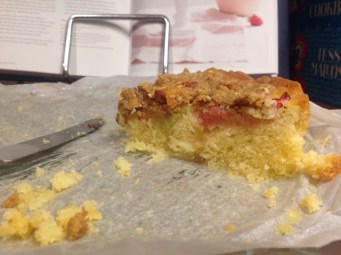
The first thing I’ve made is the Rhubarb Sour Cream Crumble Cake, which is in the ‘measure and beat’ section. Again, didn’t think I’d learn anything here, but um, I think I usually put the dry ingredients in before the wet but not consciously… so that’s an excellent pointer. And I’ve started picking up on the idea of room-temperature eggs, so this was yet another reminder about that. Guess I have to plan my baking a bit further in advance than I have tended in the past.

IMG_0889.JPGI made this because a friend gave me a pile of rhubarb sticks (whoo!), and we had people coming over for dinner. The cake batter itself turned out beautifully and I am once again glad I have a stand mixer, because it makes multitasking a reality. For some reason my crumble did not crumble, but turned into dough – perhaps too little flour? the butter was straight from the fridge but it was a fairly warm day, so that may have been a problem. At any rater I have dotted it over the top and spread it out a bit; it cooked fine and tasted perfectly nice.

Verdict in the end was very positive. We ended up with a bit left over but I think that was because our guests were being too polite to have extras.