Vegetable garden

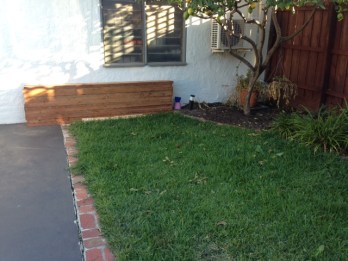
IMG_0973.JPGFirst, we bought wood, and scoped out the area where we might sacrifice some lawn to the Greater Needs of Vegetabling. That wood is 2.4m in length. It was Quite The Adventure getting it home. Let’s just say that I had to be careful where I moved my head while in the car. IMG_0974.JPG


Then came Building the Boxes. These are their final resting places but before being stuck together – we put down weed mat, of course, to prevent Evil Grass from infesting Beautiful Vegetables. Yes there’s shadow, but it should get enough sun, we think, for most of the year.

The next step was filling the boxes with dirt – a vegetable mix we got delivered. And then spent a few hours shovelling. On my beloved’s birthday. Great present, huh??

IMG_3805.JPGAnd here we have the vegetable boxes with actual plants and a watering system. The planting out involved some… false starts… well, one: I bought broad beans from Ceres, and beetroot and broccoli as well, but kind of forgot that brand new 1.5sq m of soil is likely to be quite dry. So I didn’t water them in enough. Which meant that the broad beans got totally  deaded, and I got sad. So while I was out sourdoughing, my beloved and a friend went back to Ceres… and went a little mad. Buying broad beans (good), as well as snow peas and broccoli and beetroot. Forgetting or not realising that those already exist in the garden – snow peas are sprouting in toilet roll containers As We Speak. They also didn’t think about the fact that maybe I had planted some stuff that was, like, not yet above ground? Like garlic? And that maybe I had a plan for where other things would go? The upshot is we’re going to be (hopefully) eating a rather large amount of broccoli in the coming months, and beetroot too.

Seeds I have planted in the beds: rocket and spring onions and fennel and leeks (and, in a pot, cauliflower which has maybe sprouted? Turns out I’ve forgotten which pot I put those in). None of these have sprouted yet and I’m worried that the lack of water was a problem. But now! we have an automated Very Fancy water system, c/ the beloved (as so much of this is). And, because we can, we also have hothouses. So maybe this will encourage Growth.

Vermiculture


IMG_0977.JPGA friend of ours who’s really into permaculture came over a few weeks ago and gave us a bit of a rundown about what we could change around the place. We’ve since created a vegetable patch – more on that later – and we’ve also invested in a worm farm.

We looked at the tiered system like you can get at Bunnings; we looked at the converted wheelie bins at Ceres; in the end my darling’s research powers led us to HungryBin. It sits very neatly in a corner with the wheelie bins; it’s not especially convenient to the kitchen but it’s not like we live on a massive property so that walking out is a problem.

The neat thing about this is that the ‘worm tea’ drips onto the tray at the very bottom, while the worm castings accumulate in an easily removable tray at the bottom of the bin. Apparently. We’re not there yet. Where we are is many litres of compost, about 2000 worms (apparently; it was a kilo), and beginning to add scraps. IMG_0976.JPG

This is what it looked like when I first put stuff in. I ended up taking out the mint from on top, and I’ve realised I needed to cut things up more before putting them in.

The worms seem happy in what is now being called the Earth BnB. I’m making this assumption based on the fact that they are frequently on top of the soil when I check (which isn’t every day… promise… or at least not more than once a day. Now that I’ve had it for a little while) and that the amount of food scraps is definitely decreasing.

Amusing fact: pumpkin seeds will sprout in worm farms as well as in compost.

IMG_3806.JPG

Camp cooking

Those are welding gloves, because that cast iron pot gets placed directly into the campfire. And then it has to be taken out again.

We quite like camping, of all varieties. We have more tents than would seem entirely sensible. We also have a Landcruiser troop carrier that we’ve recently kitted out with a frig, and a rather nice cooking set up. Because we also quite like cooking. The solution to either eating just Latina pasta or steak all the time, for my beloved, was this cast iron pot. Throw a mini roast in with some potatoes, a carrot, maybe a couple of shallots and as much of a tin of tomatoes and some water as will fit… put it onto the coals of the firepit you’ve had conveniently and cheerily smoking for an hour, and another hour or so later you’ve got dinner.

Things we didn’t realise: that the lid has one direction in which it sits flush. The other way around, it doesn’t. The theory is that this is for those occasions when you do want steam to escape, which I guess could be useful, but… it was frustrating when we didn’t realise.

We also didn’t realise how to care for cast iron, because it arrived sans any instructions about seasoning or care. So we found that out the hard way. Fortunately it’s not the sort of thing that can be easily destroyed, which I guess is the whole point with cast iron, right?

Anyway. The results have been… acceptable. We’ve only used it twice. Once while actually camping when we were quite pleased with how it turned out, even though frustrated by the lid. The second time was to check out how well we’d seasoned it, and that was somewhat less awesome. Partly it was because we used a larger piece of meat so it was squishier and therefore more bits of carrot ended up burnt on the side. Partly it was because cooking a la camping (we still used the firepit, in the backyard) just isn’t the same when you’re not, like, camping.

I think this is going to be a good addition to our camping experience. I think I have to find my recipe for damper as the next experiment.

Candied walnuts

IMG_0838When I moved house a year ago, the amazing Kate of Just Add Moonshine (JAM) sent a jar of candied walnuts. And oh my goodness, they really are like adult candy.

Take your walnuts and add a fair bit of sugar, sage that’s been fried in some butter, and salt and roast… and make sure that the other people in your house don’t know where they are. These will just go, because they are just so easy to eat by the handful.

I’m giving them away as Christmas presents.

Gastropod

A podcast that combines a love of food with science and history. Gastropod is pretty close to the perfect storm for me.

I discovered it via RadioLab, which is also another of the most perfect podcasts as far as I’m concerned. The hosts, Cynthia and Nicola, are both foodies and food writers – they write a lot for other venues, and Nicola at least has a blog of her own. So they have lots of knowledge and connections which they bring to bear; sometimes one is expanding on something they’ve already written an essay about, for instance.

I’ve gone back to the start of the podcast, and I’ve only listened to the first five or six episodes, but I anticipate listening all the way through until I’m up to date. The first episode was a little stilted; it was clearly scripted and they were trying to make it still conversational instead of a purely academic sort of thing. So some bits were quite awkward, but it was the first episode so I was prepared to be tolerant – and they’ve definitely improved as they’ve each got more comfortable with the format, so I’m really pleased for them and for my ears.

The episodes so far have covered really interesting topics. The first episode made me dead keen to get Bee Wilson’s Consider the Fork, about the development of culinary instruments; then they’ve talked about seaweed  (sorry, sea vegetables), and about ecological eating, and ‘The Night of the Radishes’ and the idea of ‘subnatural’ cuisines and yeh, they’re very clever and I’m really enjoying the eclectic nature of their podcasts.

Nicola is a Brit who’s lived in America for a long time. Her accent is a bit disconcerting, especially for an Australian I think.

Sweetfest

Today I went to Sweetfest and… it wasn’t quite what I was expecting. I think that’s mostly my fault; I’ve been to two craft shows this year and for some reason I thought this was going to be like that. I knew there was only going to be 20 or so exhibitors but I didn’t recognise any of the names, really, so I thought there would be a mixture of maybe cafes/food places and places selling useful gear, that sort of thing. But… no. That link earlier takes you to a page listing what each place will be selling; I’m quite sure it didn’t have that info when I bought my ticket. Because it turned out they were all cafes and patisseries, just selling food. So it wasn’t what I was expecting. I had realised there would be a lot of food and had therefore anticipated eating there; I ended up having a chocolate and cashew scroll, which was ok but not awesome, and then gelato: nutella, which was great, and raspberry and rosemary which is an awesome theory but I couldn’t taste the rosemary. It was interesting walking around looking at the pastries etc and I wish I’d been game enough to try one of Naughty Boy’s amazing shakes.

However, I was also going for the sessions, so it wasn’t a total loss. I hadn’t expected to pay attention to Katherine Sabbath’s cake icing demonstration but I was there early and a bit bored by the stalls, so I sat and watched her create this incredible tall cake – two cakes, sliced, turned into about an eight-tier monstrosity with three different coloured icings inside and ‘water-colour’ frosting on the outside (the three different colours basically smudged together). She was a very good presenter – when she said she’d been a teacher for four years, it totally made sense – and it was intriguing that she’s got famous courtesy of Instagram. I don’t get Instagram. But the cake: she was alternating chocolate mud and some sort of vanilla cake, and the frosting was pink, mustard, and violet, and it was Martha Stewart’s swiss meringue buttercream, flavoured with salted caramel. Katherine answered some questions, and she did so very well and in such a way that either she’s a very genuine and exceptionally gifted public speaker or she’s learnt very fast: no “it must be Valhrona couverture chocolate” stuff, it was ‘use what you can afford’ which I appreciated. It was fascinating watching her work – smoothing at the end with her Gyprock concrete scraper! – and it was very much a show.

Secondly, and the reason I went on the Saturday, was Philippa Sibley, apparently the Queen of Desserts although I’d not heard of her before. By comparison with Katherine she came off as almost impatient; she was efficient, a bit abrupt, precise. She did not waffle. I loved her style a lot. I was a bit sad that she didn’t go into a lot of detail about how to make the pastry – I think she was pushed for time because Katherine went way over – but her tips about pushing the pastry into the very edges of the tin, alfoil right into the edges and avoiding any creases at all, and having the overhang of pastry were deeply awesome and made me inspired to try out making tarts. Which was indeed the whole point of going to see the session. I didn’t buy her book at the time but I would consider it in future…. Sibley did not put on a show. She was doing a demonstration.

Overall I think this was a really good idea for a food festival. There needed to be more chairs for the demonstrations (they said on the programming that there was limited seating). I would go again next year with a friend, as long as the presenters sounded interesting.