 I’d been wanting this book for quite a long time when I finally saw it on sale and cracked. I like that it doesn’t just have the standard ‘Middle Eastern’ countries that I think Anglo-Australians think of when they think of food; it’s got Armenia, The Gulf States, Yemen…. So my thought was to try and do a week or two of mostly cooking from on country. Obviously that’s going to be harder or easier depending on season, as to what we feel like; and some ingredient will make things hard. But I figure it’s a good way to try new things and make my way through bits of the book.
So my first foray was into Cyprus. It’s not the first country in the book – that’s Greece – but I thought starting with Greek was cheating because I already know at least some Greek food.
The very first recipe is for haloumi. I am intrigued by the idea of making haloumi but I can’t imagine every actually doing it. Unless I hit some holidays and I get really adventurous… which may well happen, not going to lie.
I also don’t think I will be marinating or frying brains (appetisers). Yes, I happily own to being a culinary coward.
Page-wise, the first recipe I tried was the Kolketes (pumpkin pies; appetiser). This was a bit harder than I had expected. Making the filling of pumpkin and bulgur and spices was a cinch. But the pastry wasn’t nearly as easy to deal with as I had expected, and I got a bit frustrated. This was compounded by the instruction to roll the dough out “about the thickness of a normal pie crust” which is not at all useful if you’re not accustomed to making pie crusts. As I am not. So I just had to guess. Ultimately I managed to make the  pies; they were quite tasty. However the pastry has made me leary of trying them again.
Next was haloumi bread. Yes yes yes and yes. I can also imagine just making the Kouloura bread dough by itself.
Further on we hit vegetables, and I made Yemista – stuffed vegetables. I can’t quite imagine stuffing eggplants and my love isn’t a huge fan, so I just went with tomatoes and capsicum. I’d seen some American cooking show where the woman did ‘deconstructed’ stuffed capsicums – don’t worry, she was being sly about and knew this was entirely the cheat’s way of making them – and I had every intention of making the filling (mince, rice, tomato) and then piling the capsicum and tomato on top or something. But in the end I actually properly stuffed them (and how organised is this, I made that bit the day before and just had to cook them the next day for dinner!). They were quite tasty, although I think either the stuffing or the sauce (which was a very basic tomato sauce) needed something a bit richer. Possibly just more tomato.
Then there’s Afelia, which is apparently anything with cracked coriander seeds. I made mushrooms with coriander – fry them off, add some red wine, add coriander – and given I love coriander in all its forms I liked it. I would have liked more ideas in this section about what sort of food it should accompany, though. I also made the pork version, which was quite a Moment for me since I’m not sure I’ve personally cooked pork more than… once before? Basically it just tasted like coriander, though; I didn’t think the pork came through at all. Maybe that’s just pork.
Finally, fish: Psari Savoro (fish with rosemary and vinegar). I used Australian rockling. We went through a bit of a fish phase a few years ago but haven’t been back in ages; I’ve just not found a convenient and good fishmonger. There’s apparently one a bit north of where we are, though, that I’ll have to try – I think this cookbook is likely to have some good seafood recipes. Anyway: salting the fish was an intriguing suggestion, and then coating with flour of course made it crisp up a bit and leave flour to thicken the sauce. My love cooked the fish and did it very well. The sauce was made up of garlic, rosemary, vinegar (we used cider instead of brown) and white wine. It thickened up heaps more than I expected, and was basically tasty although too heavy on the vinegar for my taste. One I will quite likely be revisiting.
Starting with Cyrpus was an … interesting choice. It wasn’t an overwhelming success – I didn’t love everything – but there wasn’t anything that I hated the taste of. I’ll be a bit more cautious as I go further into the book as I’ve not always found Mallos’ instructions to be as straightforward as I’d like. With both the pork and the fish, she says to fry until ‘just cooked through’ – but no instructions about what that looks like. It’s surely not hard to say ‘until the pork is white through’ or ‘until the fish is white and flakes’? Even expert cooks aren’t going to get annoyed by a few extra words, are they?
None of these were particularly photogenic, hence the lack of pics.



 flour on the top; I presume that means it’s not combined? That cake-y type consistency at the bottom of the bowl, is that good or bad? Does it mean I’ve over-beaten? OH NO WHAT HAVE I DONE. This is the first instruction I’ve found in the book that’s not as precise as I would have appreciated.
 They didn’t rise as much as I would have hoped, as you can see. Still it must be said that these were better than the sponges I made last time, so I guess there’s hope? They were a bit fluffier, for sure.
 BakeClass was provided to me at no cost by the publisher, Murdoch Books. Available from March 2016; RRP $45.
 Caution: trying to say the name of these biscuits as an Anglo can have dangerous consequences for earworms.
 bigger than they’re meant to be.)
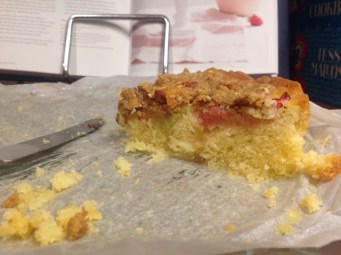 I made this because a friend gave me a pile of rhubarb sticks (whoo!), and we had people coming over for dinner. The cake batter itself turned out beautifully and I am once again glad I have a stand mixer, because it makes multitasking a reality. For some reason my crumble did not crumble, but turned into dough – perhaps too little flour? the butter was straight from the fridge but it was a fairly warm day, so that may have been a problem. At any rater I have dotted it over the top and spread it out a bit; it cooked fine and tasted perfectly nice.
 A colleague at work, with Greek-Cypriot connections, tells me that Cyrpiots will eat (non-fried) haloumi with watermelon. I’ve not tried that. What I have tried, now, is haloumi bread, or haloumopsomi. And friends, it is delightful.
 ring, you push it out into a rectangle; dot it with 250g of haloumi; then roll it up and tuck in the ends. TA DA.
 there’s little demand so the farmer asks a high price which means they don’t sell etc. However I’m told that Lebanese cucumbers work fine, so that’s what we’ve got here.
 It turns out that, of course, my mother-in-law had an old Fowlers Vacola tub from way back when J was a wee thing. I had never heard of Fowlers, but most people I’ve spoken to seem to regard them as an old friend, so we’ll just write that off as resulting from a tropical childhood. You can still buy Fowlers jars and accoutrements, and they Magically Appeared at our door soon after I announced my interest, so I feel compelled to experiment. I started today.
 The first thing that J wanted me to do was some fruit, because that’s what he remembered. So I went off to the Preston Market (first time visit – very exciting), and bought peaches (which I thought were apricots shut up what a pain to halve) and white-flesh nectarines. The picture shows that I clearly didn’t fill the bottles well enough; apparently that makes this An Experience and I deserve to be scolded for wanting to be perfect first time ’round. Whatever. I think next time I would cut them a bit smaller so as to be able to pack them a bit better… and who knows, there are probably YouTube vids out there about how best to pack your fruit for preserving… anyway
  these will be eaten sooner rather than later.
 Yes that’s some burnt bits shut up. These will be rolled in sugar and then jarred in a couple of days when they’re done with draining.
 Acts of Kitchen